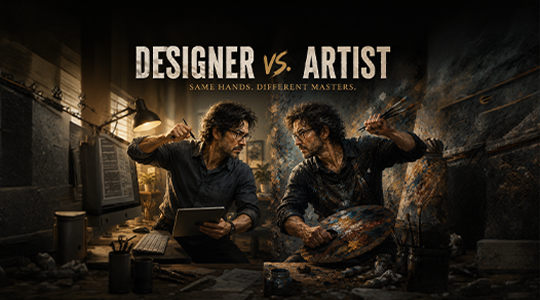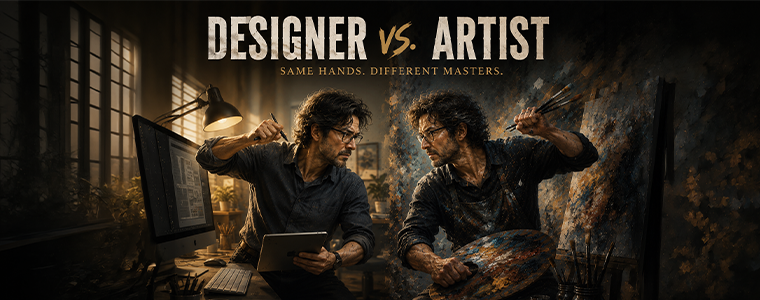
Designer vs. Artist: Same Hands, Different Masters
Every few months, someone on LinkedIn rediscovers the difference between a designer and an artist, writes 800 words about it, and gets thousands of likes for explaining what most working creatives figured out years ago.
Here’s the version I don’t see people talking about.
The difference isn’t creativity.
It’s ownership.
When the work fails, who owns the failure?
That’s the real dividing line.
Most people say designers solve problems while artists express themselves. That’s true—but it’s also the beginner’s answer. It sounds great in a portfolio review and falls apart the moment your client rejects your “perfect solution” for the third time because the CEO suddenly had a new opinion.
The better question is this:
When the work doesn’t work, who’s holding the bag?
When a design fails, it’s rarely one person’s failure.
Maybe the brief was vague. Maybe the stakeholder changed direction halfway through the project. Maybe marketing insisted on another logo, another call-to-action, another revision that slowly buried the original idea.
There’s usually a trail of shared responsibility.
That’s because design is collaborative by nature.
You’re hired to solve someone else’s problem using someone else’s budget, timeline, and objectives.
Nobody hires a designer to bare their soul.
They hire a designer to achieve a result.
Art works differently.
When an artwork fails, there’s no client to blame.
No creative brief.
No stakeholder.
No marketing department.
It’s just you and the work.
That’s the uncomfortable freedom of being an artist. If the piece succeeds, the credit is yours. If it fails, so is the silence that follows.
And strangely enough, that’s exactly what makes it art.
If You’re Being Paid, You’re Designing
Here’s the part that some creatives won’t like.
If someone hires you to solve their problem, you’re working as a designer—even if your job title says illustrator, photographer, motion artist, or multimedia artist.
You’re serving an audience that isn’t you.
You’re creating within constraints that aren’t yours.
That isn’t selling out.
That’s the profession.
Some of the greatest designers in history worked within strict limitations. Deadlines, budgets, brand guidelines, demanding clients—those weren’t obstacles. They were part of the craft.
Great designers don’t resent constraints.
They learn how to create something memorable inside them.
If Nobody Asked for It, You’re Making Art
Art begins where the brief ends.
You create because you have something to say, not because someone commissioned it.
If people connect with it, wonderful.
If someone buys it, even better.
But neither of those things determines whether the work succeeded.
The work succeeds the moment it honestly says what you wanted it to say.
The danger comes when artists begin creating only for approval.
The moment your creative decisions are driven primarily by what will sell, what will trend, or what will earn applause, you’ve quietly crossed into design thinking.
There’s nothing wrong with that.
Just don’t confuse the two.
The Mistake People Keep Making
The conversation usually turns into a false choice.
Artists are portrayed as pure creatives.
Designers become the practical professionals who sacrificed their originality for a paycheck.
I don’t believe either stereotype.
A designer who contributes nothing personal eventually becomes interchangeable. Good design always carries a fingerprint. The client may own the objective, but the designer still shapes how the solution feels.
Likewise, an artist who only chases what the market wants eventually becomes another service provider—just without a client admitting they’re the client.
Neither role is superior.
They’re simply answering different questions.
A designer asks,
“Does this solve the problem?”
An artist asks,
“Does this express something true?”
Sometimes those answers overlap.
Often they don’t.
Most Creatives Are Both
Here’s the reality after twenty-five years in this industry.
Most of us wear both hats.
On Monday, you might design a campaign around a client’s business goals.
On Saturday, you sketch an idea nobody asked for simply because you couldn’t stop thinking about it.
Neither role is more noble.
Neither is more creative.
They’re different disciplines using many of the same skills.
The challenge isn’t choosing one over the other.
The challenge is knowing which master you’re serving before you begin.
If a client is paying the bill, serve the client proudly.
If you’re creating for yourself, be honest enough not to measure the work by likes, sales, or applause.
Same hands.
Different masters.
The sooner you understand the difference, the better you’ll become at both.