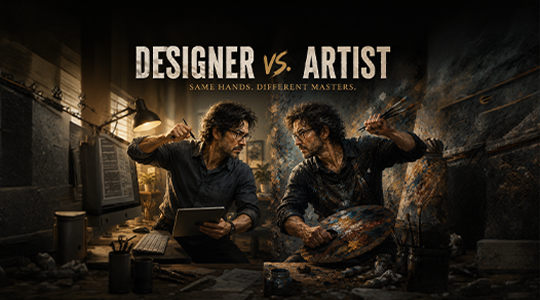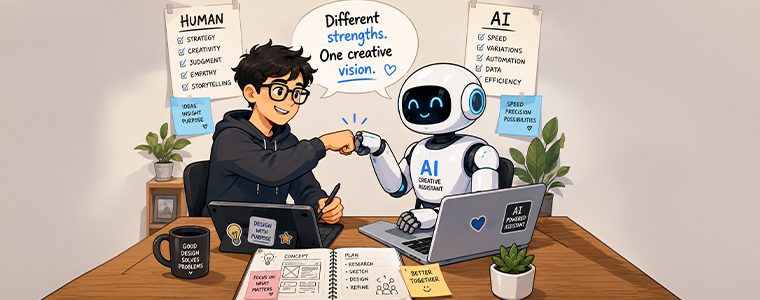
Human Designers vs. AI: Strengths, Weaknesses, and the Future of Design
I asked Claude a simple question: What is the difference between human design and AI design? What are their strengths and weaknesses?
The answer was surprisingly balanced. Instead of treating AI as a replacement for designers, it highlighted that each excels at different things.
The Core Difference
|
Human Design |
AI Design |
|
Start with purpose. Designers consider the client’s goals, the brand story, the audience, and the emotions a design should evoke. Every decision is guided by judgment and experience. |
Start with patterns. AI generates designs by recognizing and recombining information from existing data based on the prompt it receives. It predicts what is most likely to work but doesn’t truly understand the business problem it’s solving. |
In simple terms:
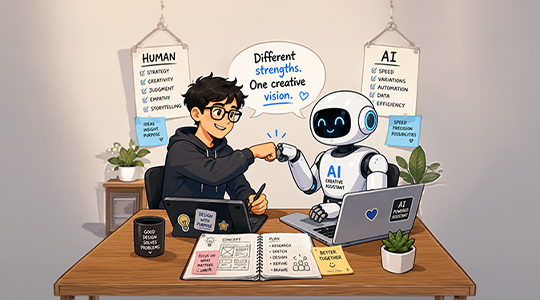
- Humans solve problems.
- AI generates possibilities.
That distinction is more important than ever.
Where Humans Excel
Human designers bring qualities that AI cannot genuinely replicate:
- Strategic thinking – connecting design decisions to business goals and customer psychology.
- Creative judgment – knowing when less is more, when to break the rules, and when to ignore trends.
- Client communication – interpreting vague feedback like “Can you make it pop?” into meaningful improvements.
- Original concepts – creating ideas inspired by experience rather than statistical patterns.
- Responsibility – making ethical, legal, and brand-sensitive decisions that AI simply cannot own.
Where AI Excels
AI shines when speed and efficiency matter.
- Generates dozens of concepts in minutes.
- Creates multiple design variations almost instantly.
- Removes backgrounds, upscales images, resizes assets, and automates repetitive production work.
- Explores styles and visual directions rapidly.
- Makes design tools accessible to people without formal design training.
AI dramatically reduces the time spent on repetitive tasks, allowing designers to focus on more meaningful work.
The Limitations
Human Designers
Even experienced designers have limitations.
- Slower production compared to AI.
- More expensive for rapid iterations.
- Can become attached to familiar styles or creative habits.
- Fatigue and inconsistency can affect long-term projects.
AI
AI also has significant weaknesses.
- It imitates patterns but doesn’t understand why they work.
- It struggles to maintain complex design systems with consistent logic.
- It often produces generic or overly familiar-looking work because it learns from existing examples.
- It lacks business context, client history, and emotional understanding.
- Copyright and training-data concerns remain important considerations for commercial projects.
My Take
After reading the comparison, I realized something.
Designers shouldn’t compete with AI.
They should compete with designers who know how to use AI effectively.
The smartest approach is to focus on what humans do best—strategy, creativity, storytelling, and decision-making—while allowing AI to handle repetitive production work.
Think of AI as your creative assistant rather than your replacement.
When designers stop spending hours on tedious tasks, they gain more time to think, experiment, communicate with clients, and create better solutions.
In the end, the future doesn’t belong to humans or AI alone.
It belongs to designers who know how to combine both.